What Birds Can Be Seen in Mikumi?
More than 400 bird species have been recorded in Mikumi National Park, spread across open grassland, seasonal swamp, riverine woodland and miombo. A Mikumi birdwatching safari commonly turns up lilac-breasted roller, yellow-throated longclaw, bateleur eagle, secretary bird, marabou and open-billed storks, with Boehm’s bee-eater and Dickinson’s kestrel in the woodland. Mikumi sits in Tanzania’s Morogoro region, four to five hours from Dar es Salaam, and its birding peaks between November and April when migrants arrive.
Below is what to look for in each habitat, when the numbers are highest, and how to build a birding day here.
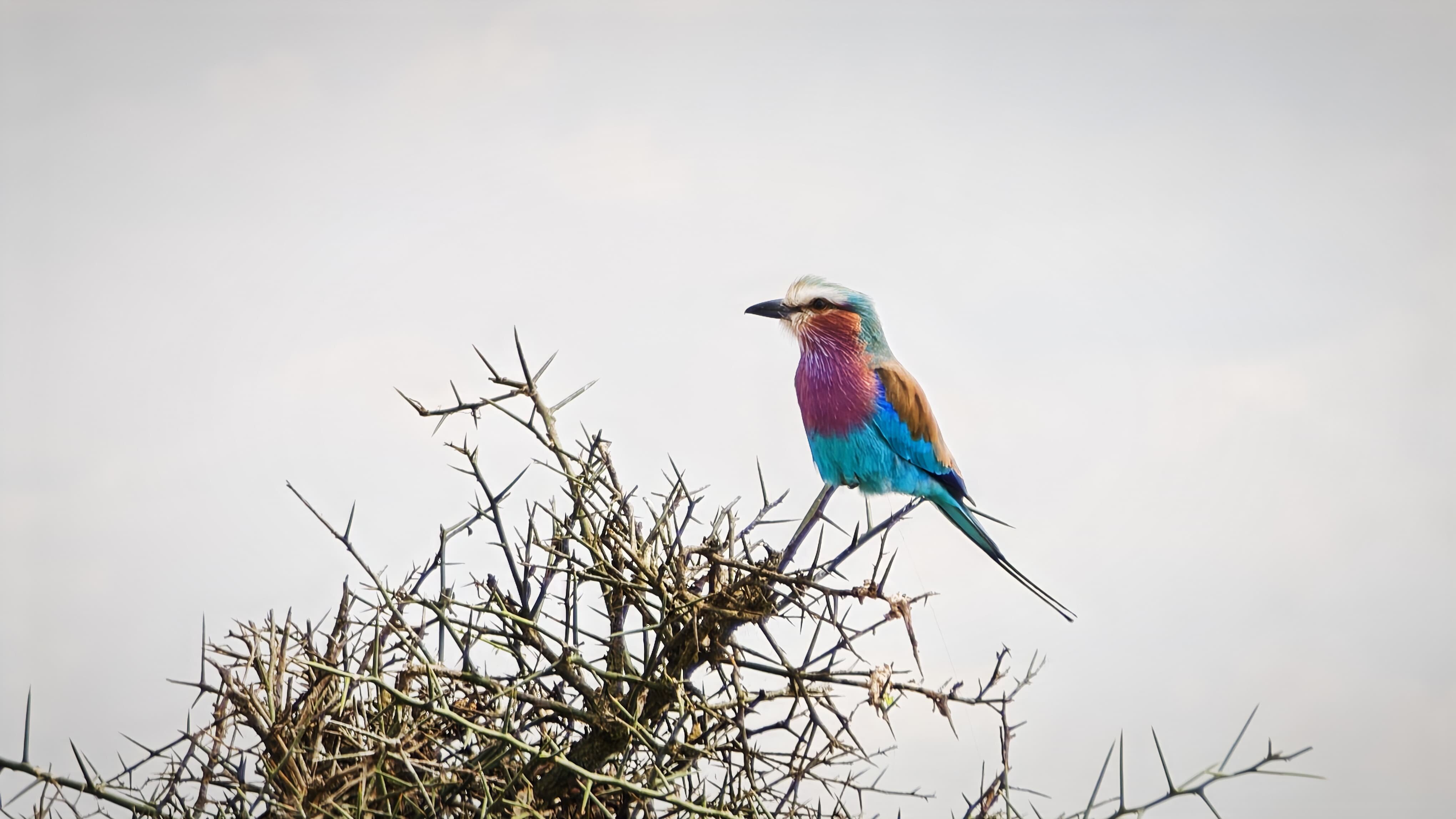
Grassland Birds on the Mkata Floodplain
The open plain carries a distinctive set of species and most of them are visible from a vehicle without any effort at all.
The lilac-breasted roller is the one everybody photographs, perching obligingly on low acacia branches along the tracks and showing that improbable blue and lilac when it drops. Yellow-throated longclaw works the grass, bright yellow throat bordered in black. Black-bellied bustard stands upright in the stems and is easy to miss until it moves.
Secretary bird stalk through the grass on those long legs, hunting snakes and lizards, and are one of the most satisfying sightings on the floodplain. Helmeted guineafowl run ahead of vehicles in noisy groups, and francolin work the verges.
Superb starling turn up around camps and picnic areas. Straw-tailed whydah and various weavers fill in the smaller end of the list.
Bring your own binoculars, one pair per person rather than one per couple. On the open floodplain most birds sit further out than they look, and sharing a pair means one of you misses the sighting entirely.
Raptors and Birds of Prey on a Mikumi Safari
Raptors do well in Mikumi because the mix of open grass, woodland edge and water gives them everything they need.
Bateleur eagle is the signature bird, quartering the plain on that distinctive tailless silhouette with the rocking flight that gives it its name. Martial eagle hunts over the same ground and takes considerably larger prey.
African fish eagle call from the taller trees along the Mkata River and around the hippo pools, and that call carries far enough to be one of the sounds people remember from the park.
Dickinson’s kestrel occurs in the woodland. Vultures gather at carcasses across the plain, and the transition strip where miombo meets grassland is often the most productive place of all for raptors.
Waterbirds at the Hippo Pools and Waterholes
Permanent water in country that dries out for half the year concentrates birds, and Mikumi’s pools are where a birding list builds fastest.
Open-billed storks gather around the hippo in flocks, working the mud the animals churn up for snails and mussels. That combination of hippo and storks in the same few metres of water is one of the images the park is known for.
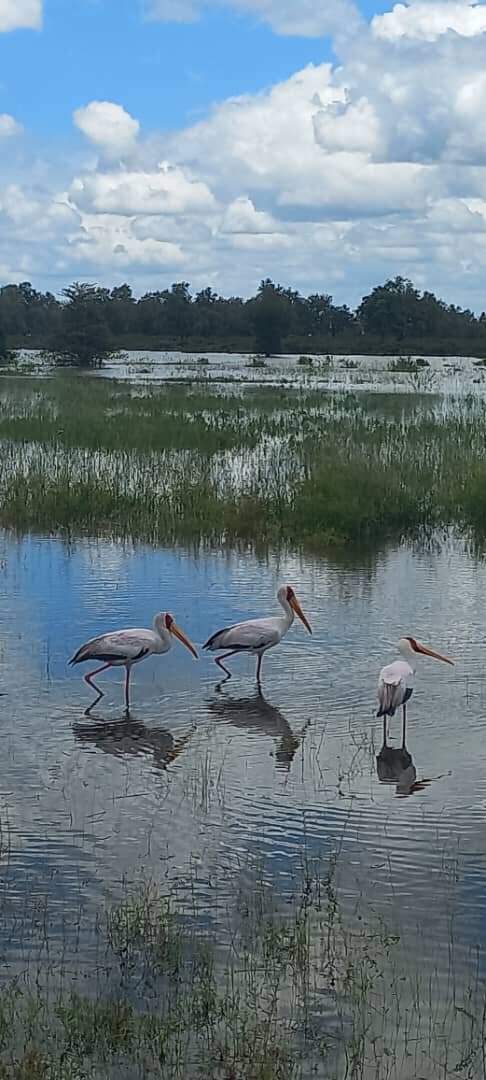
Yellow-billed stork, saddle-billed stork, marabou, hamerkop, herons and egrets all use the same margins. Saddle-billed stork are unmistakable with the red and black bill and are most often reported at Chamgore.
Malachite kingfisher hunt from reed stems, small and impossibly bright, and are worth the wait even if nothing larger turns up. Blacksmith plovers and cattle egrets are named repeatedly in wet season accounts.
Miombo Woodland Birds in the Mikumi Foothills
Where the plain lifts toward the mountains and grassland gives way to brachystegia, the bird community changes completely, and this is where a serious list gets interesting.
Boehm’s bee-eater is the species birders come for, alongside Dickinson’s kestrel. Hornbills work the canopy, with ground hornbill on the woodland fringe. Mixed feeding parties move through the trees together, which is a miombo characteristic and rewards sitting still for ten minutes when you find one.
The woodland sits in the southern and southwestern parts of the park, toward the Vuma Hills. Sources note that game viewing concentrates in the northwest while the southwest is better for birding, which is a useful division to know when planning a day.
Vuma Hills Tented Camp sits up in this country and stays open year round, which puts the woodland species on your doorstep.
Mikumi’s grassland birds come to you. Its woodland birds do not, and the difference between a fifty species trip and a hundred species trip is whether you spent a morning in the miombo.
Riverine Woodland Birds Along the Mkata River
The narrow band of acacia and tamarind fringing the Mkata River holds a different community again, denser and harder to work than the open plain.
Open-billed storks fish the shallows here. African fish eagle use the taller trees. Kingfishers, bee-eaters and various warblers use the thicker cover, and the strip supports more small birds than anywhere else in the park.
This corridor is also where guided walking safaris tend to run, and walking is a far better way to bird it than driving. On foot you hear calls that engine noise masks entirely, and a ranger who knows the songs makes the difference.
Walks last three to four hours in the early morning and need booking in advance.
Migrant Birds and the Best Season for Mikumi Birdwatching
Birding in Mikumi runs on the opposite calendar to mammal viewing, which is genuinely useful for anyone whose dates fall in the wet season.
From November through April, European and North African migrants arrive and push the recorded numbers up sharply. Blacksmith plovers, cattle egrets, various herons and fish eagles all feature in wet season accounts, alongside the resident cast.
Residents are also at their best then, in breeding plumage, actively nesting and in full song. The green cover that hides mammals does very little to hide birds sitting on top of it.
December through February is the sweet spot for a dedicated birding trip, combining full migrant numbers with better access than March or April brings. May is also worth noting, when residents finish breeding and migrants gather before heading north.
November to April: European and North African migrants present, residents breeding and in song. The strongest birding of the year, with December to February offering the best access alongside the numbers.
June to October: resident species only, concentrated at the shrinking water. Easier driving and better mammal viewing, with the pools carrying most of the birdlife.
May: transitional. Residents finishing their breeding season and migrants gathering before flying north, with improving access as the rains ease.
Nocturnal Birds and Night Drives in Mikumi
Mikumi is one of a short list of Tanzanian parks where night game drives are permitted, alongside Ruaha, Katavi, Tarangire, Lake Manyara and Nyerere, and that opens a part of the bird list most visitors never reach.
Nightjars work the tracks after dark, sitting on the warm surface and lifting away in front of the vehicle. Owls call from the woodland edge, and a spotlight picks up eyeshine that turns out to be a bird as often as a mammal.
Drives run roughly eight until eleven in the evening with an armed ranger and a vehicle fitted for the purpose, and they need booking in advance. Charges run around US$50 per adult non-resident.
It is a small addition to a birding list and a genuinely different couple of hours.
Where to Base a Birdwatching Safari in Mikumi
For water birds, base yourself where you can reach the hippo pools and the Chamgore and Mkata waterholes early. Mikumi Wildlife Camp near park headquarters is minutes from the pools and has its own waterhole in front of it.
For woodland species, Vuma Hills in the southwest puts you in the miombo without a long drive first, and it stays open all year, which matters if you are travelling in the wet months when birding is at its best.
Stanley’s Kopje overlooks the Mwanamboga waterhole from a rocky kopje, giving an elevated view over water, though it closes through the wettest stretch of the year.
Lodges outside the boundary near Mikumi town operate year round and cost less, at the price of a fresh park entry each morning.
Getting to Mikumi for a Birding Trip
The main gate sits on the Tanzam highway roughly 283 to 300 kilometres from Dar es Salaam, four to five hours by road via Morogoro. The route is surfaced throughout, so access to the park is reliable in every month even when tracks inside are poor.
In the wet season, when birding peaks, four wheel drive becomes necessary inside the park and some tracks are impassable in March and April. Plan accordingly if you want to reach the miombo.
Kikoboga airstrip inside the park handles light aircraft from Dar es Salaam, Zanzibar, Nyerere and Ruaha. Gates open at first light and close at six.
Questions About Birdwatching in Mikumi
How many bird species are in Mikumi National Park?
More than 400 species have been recorded, spread across grassland, seasonal swamp, riverine woodland and miombo. Some older sources cite over 300, but the higher figure appears consistently in current park material.
What does a birding trip to Mikumi cost?
There is no separate birding fee. Park entry currently runs around US$30 per adult foreign non-resident per day and about US$10 for children aged 5 to 15, with lower rates for Tanzanian residents and East African citizens. A six to twelve seat safari vehicle adds roughly US$40 per day. A guided walking safari, which is the best way to bird the river corridor, costs about US$20 for one to four hours or US$25 for longer.
When is the best time for birdwatching in Mikumi?
November through April, when European and North African migrants arrive and residents are breeding. December to February is the sweet spot, combining full migrant numbers with better access than March and April, when heavy rain makes some tracks impassable.
Which part of Mikumi is best for birds?
The hippo pools and the Chamgore and Mkata waterholes for waterbirds, the Mkata River corridor for riverine species, and the miombo woodland toward the Vuma Hills in the southwest for woodland specialists such as Boehm’s bee-eater and Dickinson’s kestrel. Game viewing concentrates in the northwest while the southwest is better for birding.
Can I bird on foot in Mikumi?
Yes, on a guided walking safari with an armed ranger, usually along the Mkata River corridor or near the hippo pools. Walks run three to four hours in the early morning and need booking in advance. Walking is far better for birding than driving, since engine noise masks most calls.
Do I need a guide to bird in Mikumi?
You need a vehicle and a driver to enter the park at all, so a guide comes with the territory. Whether that guide knows birds properly varies, so ask when booking. Bring your own binoculars and a field guide to East African birds, since neither is supplied.
Booking Your Mikumi Trip
The safari companies and tour operators listed on this website put trips like this together for a living and know which camps, guides and routes actually deliver. We are an independent guide to Mikumi; we do not book or sell tours ourselves.
When you are ready, arrange your safari, tour or holiday with one of the recognised operators listed here. Tell them your dates and what matters most, and a real person, not a form, will handle the itinerary, park bookings and logistics for you.